
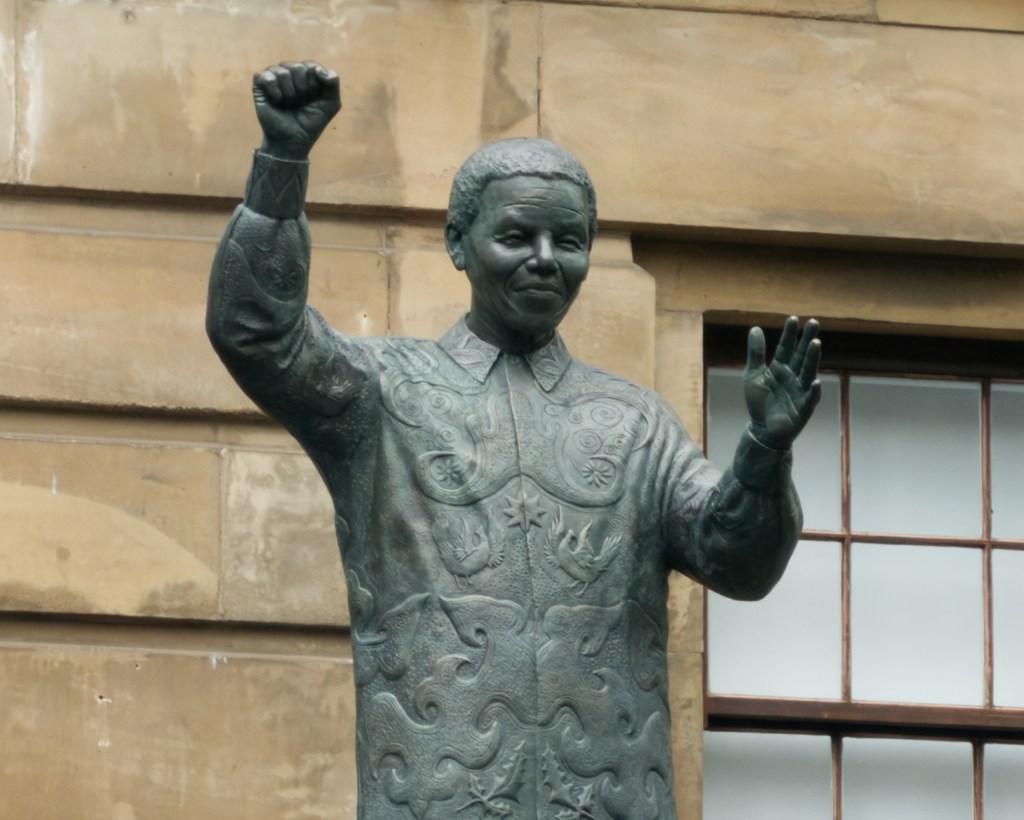
Last month, Glasgow unveiled a new sculpture of Nelson Mandela in bronze, perched on a base of the finest Aberdeen granite, to celebrate the city’s long-term involvement in the struggle against Apartheid. Glasgow was an early advocate of anti-Apartheid sentiment, during a time when many in British society and the media were trying to excuse the South African government’s racial – indeed, racist – practices, in manner that many see parallels with Israel today.
However, while Glasgow’s involvement – such as giving Mandela the keys to the city or naming public squares after him – may have been largely rhetorical, in the realms of the symbolic, some places were more actively involved in the struggle. Direct British involvement on the ground in South Africa is a lesser-known factor, and the fascinating subject of Gordon Main’s new film, Comrade Tambo’s London Recruits. This compelling docu-drama recounts how, while Mandela was imprisoned on Robben Island, Oliver Tambo set out to create an international network of anti-Apartheid activists, with a mix of interviews, archive and reconstructions of the events, which Variety hailed as “an edge-of-the-seat documentary thriller set in the early 1970s, blending elements of espionage, courage, sacrifice and jaw-dropping twists.”

The film, which has won awards on the festival circuit, will be opening this year’s Havana Glasgow Film Festival – but where’s the Cuban connection?
Cuba, in fact, had quite a history of being involved in the Pan-African struggle against Colonialism, from 1961 onwards. If the first Cuban intervention would be in the Algerian War of Independence, invoking the wrath of Charles De Gaulle, soon the country would be Congo, where Che Guevara would attempt to unite guerilla forces in the chaos following the assassination of Patrice Lumumba. Then, on to Guinea-Bissau, and Cape Verde.
While the newly liberated society of Cuba was keen to export its revolutionary fervor and expand Guevara’s concept of foquismo – guerrilla revolution – the island’s motives weren’t always entirely altruistic. Fidel Castro was canny and realised in the aftermath of the Cuban Missile Crisis, where the Soviet Union ultimately acquiesced to the US, that Cuba needed allies all over the world, wherever she could find them, and make them. As one revolutionary, Victor Dreke put it, “Cuba defends itself by attacking the aggressor”.
This policy would continue throughout the 1970s, even after Che Guevara’s murder in Bolivia, as Cuba would send 12,000 soldiers to Ethiopia to help out there, and, most importantly, became involved in Angola, in 1975.
Angola had become independent from Portugal in 1974, but chaos ensued, and Castro decided to back the MPLA (Angolan Movement for People’s Liberation) against insurgent rival groups. While the MPLA held the capital, Luanda, and was acknowledged even by the US as the most competent group to run the country, the FNLA (National Front for the Liberation of Angola) and UNITA (National Union for the Total Independence of Angola) were working in tandem to destabilise them, with the aim of ousting the MPLA from Luanda before the first anniversary of independence. UNITA’s leader, Joseph Savimbi, would receive backing from the South African Defense Force (SADF), hopeful that Savimbi’s entrance into Luanba would earn them an ally in South Africa’s occupation of Namibia. Indeed, he would be aided and enabled by Mobutu in Congo, France, China and – of course – the US. Cuba implemented Operation Carlotta, named in honour of a Cuban slave who had mounted an uprising in 1843 – with backing from Jamaica, Barbados and Guyana – which saw Cuban elite forces joining with the MPLA to triumph over their adversaries at the battle of Quifangondo.
The military initiative, taken without consultation with the Soviets, took everyone by surprise – not least Henry Kissinger, who feared a domino effect rippling across Southern Africa, as leftist forces in Angola and Mozambique prevailed. One man from Soweto, speaking to The New York Times, was quoted as saying, “In Rhodesia they are talking, and after ten years they have nothing. In Angola and Mozambique, they have won.”
Three months after making this statement, the Soweto riots would erupt.
South Africa did not take this lying down, operating raids from Namibia – which functioned as a buffer zone – into Southern Angola over the next decade. Savimbi maintained his hold in the southeast in a region so remote it was known colloquially as ‘the end of the world’. Tens of thousands of Cuban troops were stuck in a stalemate which crippled the country, while the Soviets (who were by now involved with the conflict) argued with the Cubans to prosecute a more conventional war than the Cubans’ guerilla tactics. The Cuban approach would turn out to be the more effective one. After an attack on Savimbi’s stronghold of Jamba was foiled by superior South African firepower, the Angolan militants retreated to the village of Cuito Cuanavale, where they were held under siege. Castro, who by now had sent 55.000 Cuban troops in, set a trap, concentrating the SADF on Cuito Cuanavale, while sending Cuban troops to the southwest, where they could access the Namibian border.
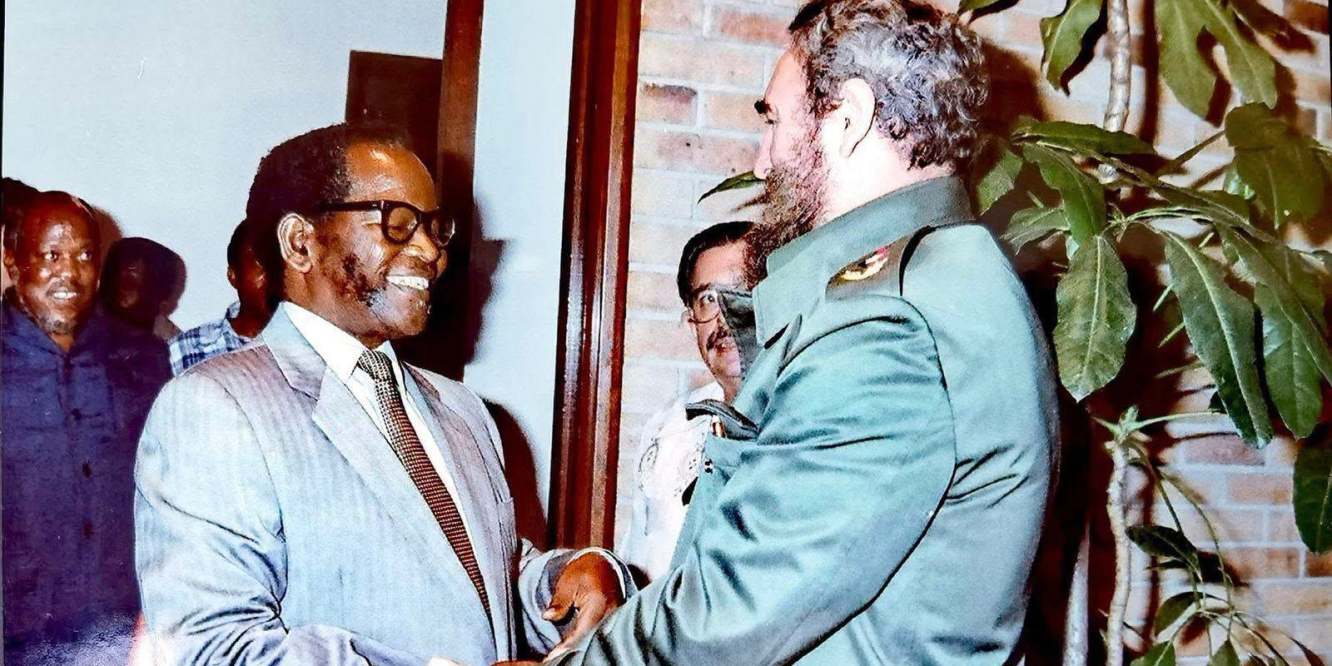
The SADF depended on the Calueque hydroelectric dam for resources for operations. When the Cuban Airforce bombed the dam, in June 1988, air superiority was established, and the SADF had no chance of winning, leading to a decisive turning point, and victory for the MPLA. The battle of Cuito Cuanavale would be hailed in South Africa as a seminal event. Nelson Mandela, on a visit to Cuba in 1991 remarked that “Without the defeat of Cuito Cuanavale our organisations would not have been legalised. Cuito Cuanavale marks the divide between in the struggle for the liberation of Southern Africa.”
While Cuba also provided medical aid to the territory, their military intervention would prove decisive. And today, the names of 2,700 Cuban soldiers who died there are commemorated alongside the fallen South Africans in the fight against Apartheid.
