
By Brian Beadie

Satire has long been one of the most fertile and productive of literary genres, from
Aristophanes in ancient Greece, flourishing under Rome (a very fitting subject) where it
became recognised as a distinct form. It would become resurgent during the Renaissance,
from France with Rabelais (whose very name would become an adjective for one strain of
the beast) to Scotland, where David Lindsay’s “Ane Satyre of the Three Estaits” would
become the first major Scottish theatrical work. Going through a Golden Age in the
eighteenth century with the likes of Voltaire and Swift, it continues to be a vital force in
contemporary literature, from the paranoid metafictions of American anarchist author
Thomas Pynchon to the brutal assault carried out on liberal values by Michel Houellebecq in
France.
In cinema as in literature. From the surrealist stylings of Bunuel or the verbal and visual
slapstick of Marx Brothers in the days of late silent/early sound cinema, to the like of Jordan
Peele or Boots Riley today, who’ve found satire the best manner in which to explore the
horrors of contemporary racism (the former’s “Get Out”) or capitalism (the latter’s “Sorry
To Bother You”), satire has long been a massively popular from with both audiences and
critics.
While satire flourishes in the so-called ‘free world’, there’s also a fascinating history of satire
in Communist countries, where the stakes can be higher, and expression allegedly more
limited. In Cuban cinema, the master of satire is undoubtedly Tomás Gutiérrez Alea, whose
“Death of a Bureaucrat” I once called “the funniest film ever made under Communism”
when it screened at HGFF. Obviously, I didn’t know what I was talking about, because I
hadn’t yet seen Péter Bacsó’s The Witness, a satire on Stalinism in Hungary which, with its
Communist amusement park featuring a Ghost Train based on Das Kapital, has to be seen to
be believed. Except no one did see it, because it was banned for 20 years, though it is
definitely the funniest film ever made in Hungary, one of the perils of making satire in a
country more noted for some of the most lugubrious, if greatest, films ever.
One thing for sure is that artists, and people in general, have a deep need to laugh at – and
criticise – the structures and social practices of their societies.
Satire is certainly thriving in Cuba, where the country’s most popular current practitioner is
Eduardo del Llano, who he had worked as a screenwriter with Cuba’s premiere filmmaker,
Fernando Perez, as a writer he found fame with his stories charting the progress of a Cuban
everyman called Nicanor O’Donnell. While, in the stories he may be described as being
“skinny and bald with bad skin”, he would become massively popular in a series of shorts
played by the charismatic actor Luis Alberto Garcia, a former guest of the festival.
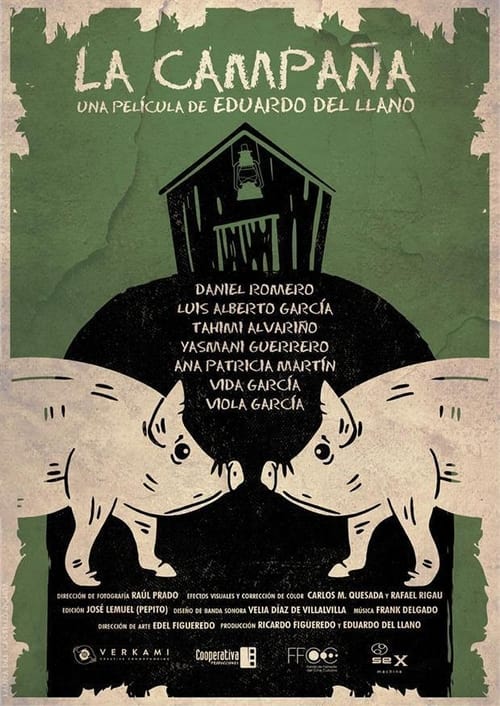
Two of these films will be screened, alongside a new film La campaña
(The Campaign), a film set in the aftermath of the Cuban Revolution, in 1961, where
advocates of the pioneering Literacy Project venture into the remotest parts of the island to
educate the locals, only to meet more than they’ve bargained for in the autodidacts of the
sticks.
I spoke to Eduardo in Havana ahead of the screening, a gregarious, funny guy, who did
remind me a bit of one of his avowed inspirations, Michael Moore. We were looking
forward to greeting him in Glasgow, but visa issues put paid to that.
HGFF – Your background is as a writer – how did you graduate from literature to film?
Eduardo – I studied History of Art in Havana University, which is not something that gives
you authority as a writer, and I used to write since I was a kid, long before I studied at the
university. This gave me a cultural background that was very important for my formation. At
one point there was a Cuban filmmaker, Daniel Diaz Torres, who read some of our stories,
he said “I like these guys’’ and met us. So we did a script, but after several scripts and many
years, a musician called Frank Delgado, who I’ve worked with on all my films, said “Why
don’t we do a film and you direct it?” And I said, ‘’Why not?’’ I was having a midlife crisis, so
said “Let’s do it!” But I had no formation or grounds as a filmmaker, although I’d been on
lots of shoots, for example for Fernando Perez, as a witness, as a scriptwriter who happens
to be there.
HGFF – Do you want to speak about the NOS-Y-OTROS quartet, and how that may have
informed your work?
Eduardo – We were friends, who started just writing then performing in theatres, which got
me used to collective work, and accepting the ideas of others. There was always some kind
of competition – as you can imagine – inside a group, which increased my imagination, and
made me think fast, which was useful for my future work.

HGFF – You work extensively with Luis Alberto Garcia – how has working with him affected
your film career?
Eduardo – Probably the best actor in Cuba – he can do comedy, he can do everything. It was
very important for me that an actor of such quality would say ‘yes’ to a filmmaker like me,
with no formal background or technical equipment, just for the fun of it, because he liked
the idea. He brought the other actors, and taught me a lot. He didn’t need Nicanor to be
famous, but he’s contributed to his fame, because he’s a very popular character.
HGFF – Do you think that there is a specific Cuban experience, and how is that expressed in
Cuban literature and film?
Eduardo – Asking about the Cuban experience is like asking about ‘The Russian soul’. Cuba is
supposed to be a Communist country, but it never existed. There was supposed to be a final
stage, after socialism developed, according to the theory. It was only a Communist country
because it was aligned with the Soviet Union. Being so close to the States was like a curse
being on you, because there was a Cold War going on. There a now a lot of Cubans living
abroad, most of whom are very anti-Communist, and often saying things about Cuba and
the Cuban system that are untrue. Every time I go to a film festival, the first question they
ask is about censorship, or Castro, and I’m like “Come on, give me a break. Let’s talk about
the art, about the influences on my work, the movies I love”. It’s like a curse you have to live
with, but on the other hand, it’s a blessing as well. I’ve been living in Spain for a few months
every year, and it’s difficult to do something out of Cuba, at least for me, to get money, or
to get someone interested in my work. But in Cuba, for all the problems we have, I’ve made
a lot of films, published several books, but I never think of success in the terms of someone
like Leonardo Pardua had in Spain.
HGFF – You’re one of the relatively few entirely independent Cuban filmmakers I’ve met.
How does the Cuban independent film sector work, and how does it intersect with ICAIC?
Eduardo – There has been a strong Cuban independent film movement for some decades
now, though it’s not always so easy to define. After one of my films won a prize, ICAIC
stepped in with post-production. I never asked anyone for permission to become a satirical
author or filmmaker, though sometimes you have to ask for permission to shoot in certain
places. Obviously, if you’re going to shoot in the middle of a road, you need to get the police
to close it off. And while I started The Campaign as an internet project, when I ran out of
money, ICAIC helped me make it as a film.
HGFF – Is there a strong tradition of satire in Cuban cinema and literature (well, I know I’ve
seen Alea’s films) and how does your work fit into that?
Eduardo – There is a strong tradition of satire in Cuban films, but I’m not necessarily making
comedy because of that. When I was a student, I loved Monty Python, I loved Woody Allen.
I loved Milan Kundera, Mark Twain, Chekhov – all these guys are like idols to me. Terry
Pratchett, Tom Sharpe, the British-South African writer – all of this literature is my
background, like British rock music is. The Rolling Stones are my favourite band, though I
like a lot of Cuban music as well.
HGFF – The festival has listed you as a ‘punk rock satirist’. Do you think that’s a valid
description? If so, what does punk mean to you?
Eduardo – Musically speaking, I’m not a fan of punk. I’m almost 62 years old – but I’m still
thinking of the future, what is wrong is wrong, and I have fights with Cuban authorities,
because I consider myself a Leftist, a progressive, but for the authorities, I’m sometimes not
Leftist enough, while for the opposition, I’m too Leftist. So it’s complicated – but it’s fun. It
certainly provides good material for films.
HGFF – I love the way that you parodied one of the sacred cows of Cuban society – the
revolution and the Literacy Project – in La campaña. How easy is it to be a satirist in Cuba?
How do you approach the subject?
Eduardo – I do believe in the concept of Utopia, as in socialism. Not necessarily when it gets
real, in Europe or in Cuba, but I believe in the idea. And to me, criticising what is wrong is
the best way to be a human being, definitely to be an artist. I have to be honest – I’ve been
censored a few times in my life, but I’ve never been ejected from my work, or in prison, or
prevented from leaving Cuba. I don’t think I’m an exception – Cuba is everything you have
read, and everything you haven’t read about Cuba.
