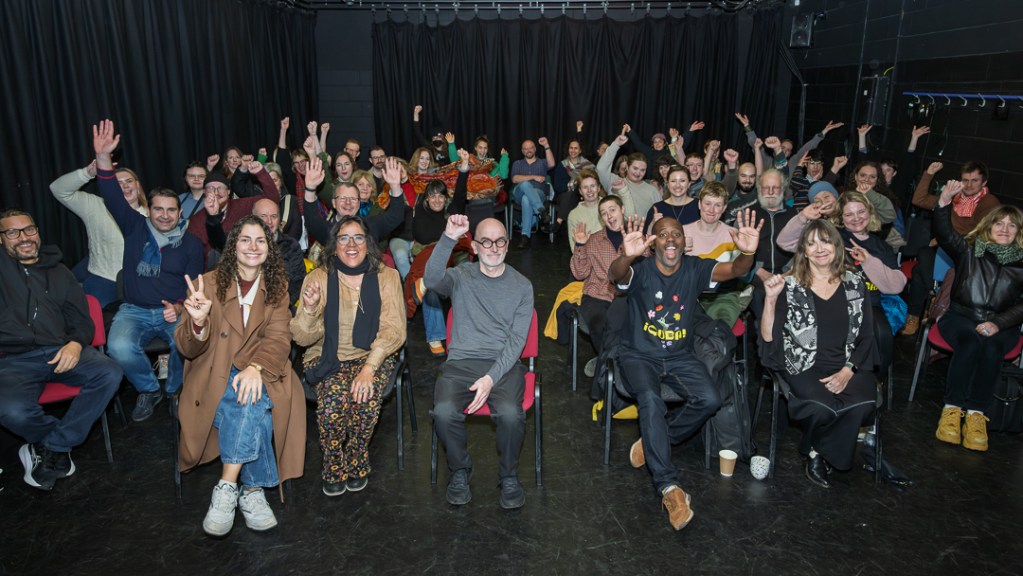
Film montage by Dani Acosta showing the highlights of our Anniversary Festival
Havana Glasgow Film Festival celebrated its tenth anniversary this year, with a celebration of solidarity and kindness, two commodities in rather short supply in these brutal times. Glasgow is commemorating its 850th year in a rather muted fashion, with financial uncertainty particularly affecting the city’s arts scene. Meanwhile, the capital of Cuba, like the entire island, is struggling under the effects of a harsh US trade embargo. Both cities are resilient though, and have a long history of combatting adversity with music, art, partying and – often dark – humour.

The festival, founded in 2015 by Eirene Houston in Glasgow, working with Hugo Rivalta in Havana, has come a long way over that time, and has developed an enthusiastic audience with a taste for Cuban film and music. I was invited to review it in its second year, and to become a team member a couple of years later – it’s been really gratifying to see it grow, and be part of it.
The opening event was an exploration of that most democratic form of transport, the bicycle. CCA’s gallery space was the location for looped images from Esther Johnson’s film Dust and Metal, an exploration of Vietnam’s love affair with the bicycle, focussing on haunting archival images from that film. This both served as a prelude for a weekend of Vietnamese-Cuban solidarity, and for that evening’s programme of short films on cycling in Cuba and elsewhere, powered by electricity generated by cyclists in the cinema, moving from the adoption of the bike as a means of transport in the ‘Special Period’ following the collapse of the Soviet Union and resultant fuel shortages, to the bike’s role as a means of exploitation in the gig economy in the capitalist economies of Germany and Scotland. If none of these films were great shakes cinematically, they formed a useful platform for a debate on the role of the bicycle in exploring urban space and fostering networks amongst cyclists.
A centrepiece of the festival was a celebration of the work of Tomás Gutiérrez Alea, the most celebrated director of narrative features in Cuban cinematic history, with his widow Mirta Ibarra in attendance. Gamely battling illness, she provided a valuable introduction and context to his 1983 film Hasta cierto punto, (Up To a Certain Point), a critique of machismo and alleged ‘male feminists’ which, while dated in certain respects, unfortunately proved all too relevant in others.
Mirta had to excuse herself for the second screening, Los sobrevivientes (The Survivors, 1979), a Bunuelian satire about a haute bourgeois family trying to sustain their privilege in the face of the Cuban Revolution, Isolating themselves from society, they degenerate into incestuous society weddings, fox hunts around their mansion with cats replacing foxes, and – eventually – cannibalism. Fortunately, the audience saw the funny side, and it proves as popular with them as with Cuban audiences, for whom it’s a cult classic.
One of the most anticipated screenings was the UK premiere of Eirene Houston and Hugo Rivalta’s documentary Life is Dance, which was a sellout show at GFT1, an observational documentary following several characters around Cuba and showing the importance of music and dance in their lives, from an older lady trying to get her Soviet-era record player fixed to a group of young Reggaeton dancers eager to become the next big thing. This film benefited enormously from the intimacy with the characters, who were really engaging, and the tactile cinematography of Roberto Chile, who almost made you feel you were there.

Another stone cold classic of Cuban cinema played on Friday night, Alea’s La Ultima Cena (The Last Supper, 1976), a brutal satire on the intersection of Christianity and colonialism. Based on a real event from the 18th century, when a nobleman invited his slaves to enjoy a Good Friday feast with him, with a terrible aftermath, the film’s centrepiece of the meal evokes Bunuel’s Viridiana; this film is equally acute on the hypocrisy of liberals, and the church. The sharpest film I’ve seen on the horrors of slavery, this is a White Saviour free zone, a film which takes no prisoners, although one of the slaves appears to escape with his life at the end.
Saturday saw a celebration of Cuban and Vietnamese solidarity, with some rare screenings of newsreels. In these films, aimed at the Cuban general public, topics ranged from domestic news to the Troubles in Northern Ireland. The latter film was especially fascinating in adopting a radical perspective from a Marxian viewpoint, far removed from how this conflict was presented in British media at the time. His son, Osain Álvarez, was present to give a valuable insight into his father’s filmmaking process.
Possibly even rarer is Trần Văn Thủy’s film The Story of Kindness, or How To Behave – a Vietnamese film from 1985 which was screened from an Australian VHS TV rip, but still worked its elusive magic. A discursive essay film which begins by contemplating the recent deaths of the director’s friends, it comes to centre on one of them, who urged Văn Thủy to consider the concept of “tu te,” human relations, fraternity and solidarity. Moving out to explore the concept in Vietnamese society in the aftermath of and reconstruction after the Vietnam War, there is much irony, and some criticism of that society, as the film’s subtitle suggests. This was too much for the Vietnamese government of the time, who banned the film, although it is now more widely appreciated.
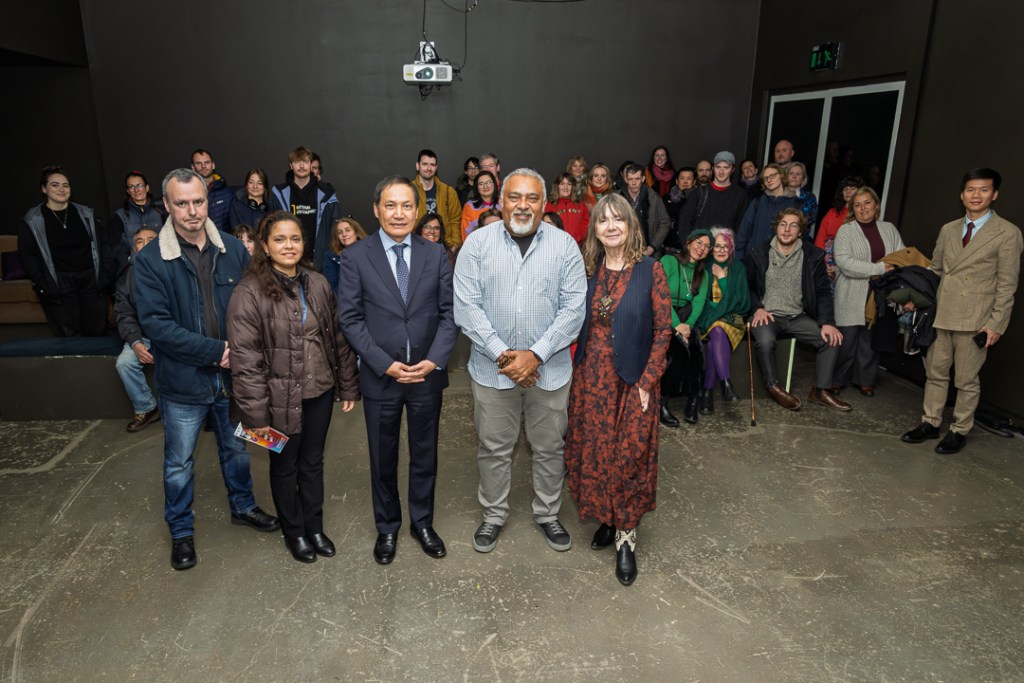
Everyone then convened for speeches from the Cuban and Vietnamese embassy, delivered in front of a beautiful backdrop of Cuban revolutionary posters. Then a Vietnamese feast, courtesy of local Vietnamese restaurant Non Viet, which everyone definitely did enjoy.
The evening screening was mainly taken up by a film Osain Álvarez had made with Rodrigo Vázquez about the work of Osain’s father – Vietnam Through the Eyes of Santiago Alvarez – where Osain retraced his steps from Havana to Hanoi, finding out both his father’s legacy and that of the war, coming to focus on the terrible after-effects of Agent Orange. It turns out that’s what was killing Văn Thủy’s friends, via cancer, although the chemical’s terrible effects on unborn children still linger today as they enter middle age. A deeply emotive film, this earned a standing ovation for the filmmaker, who eloquently held court afterwards.
The film was also a perfect introduction to two of Alvarez’s greatest films, Hanoi, Martes 13 (Hanoi, Tuesday 13 and 79 Primaveras (79 Springs). Beginning with a satirical depiction of the birth of Lyndon B. Johnson (who Alvarez had savaged in his previous film LBJ), this film draws a parallel between the between the US and Vietnam as it becomes a lyrical documentary depicting the people and locales Alvarez’s son sought out in his film, exploring rural and city life, before it’s brutally ripped apart by American bombing. In the final analysis, the US is found severely wanting, with Álvarez characteristically subverting montage and music – in this case, pairing LBJ with Napoleon XIV’s novelty hit, They’re Coming to Take Me Away Ha-Haaa!
Álvarez demonstrated considerably more respect when considering the legacy of Ho Chi Minh, the 79 Springs of that film’s title referring to the amount of years the Vietnamese leader lived. What isn’t so well known is that Ho Chi Minh was a poet, and this film’s entire script is text taken from his body of work, alongside the Cuban national poet of revolution José Martí, to create a work that genuinely functions as poetry (with a psychedelic soundtrack courtesy of Iron Butterfly).

In doing so, Álvarez stresses the links between Cuba and Vietnam, and places them within the wider anti-colonial struggles then taking place in the world. As a title warns us of the importance of unity, and the consequences of not standing together, the very film (combat footage from Vietnam) seems to come unstuck from the projector and burn itself out, in a staggering sequence which creates a potent metaphor, and illustrates the festival’s theme of solidarity beautifully.
One group who the Left haven’t always demonstrated solidarity with – especially in Cuba – are the LGBTQ+ community, who were the subject of the closing film, ¡Quba!. Presented in collaboration with SQIFF (Scottish Queer International Film Festival), Kim Anno’s film charts the island’s history of dealing with LGBTQ rights, focussing on the recent passing of the Family Code, which enshrined these rights in law, and the Christian backlash against them. Showcasing the wit and humanity of queer activists such as Ramón Silverio, founder of the groundbreaking club and social space El Mejunje, the film presents a convincing argument for a revolution of everyday life, vividly brought to life by Roberto Chile’s tactile cinematography. Ultimately, the festival’s themes of kindness and solidarity couldn’t have asked for a better illustration.